Get our template and make your research easy
09/02/2026 04:29 pm
7 min read

Article by Tiberius Dourado
Chief Editor

BLOG
Get our template and make your research easy
09/02/2026 04:29 pm
7 min read
Article by Tiberius Dourado
Chief Editor
You just hung up the phone after a screening call, and you have an interview scheduled for tomorrow morning. The initial excitement of landing the meeting quickly fades into a specific kind of anxiety: the realization that you know almost nothing about the company aside from what was listed in the job description.
In the world of job hunting, preparation is the currency of confidence, but few of us have hours to spend digging through annual reports or scrolling through endless social media feeds.
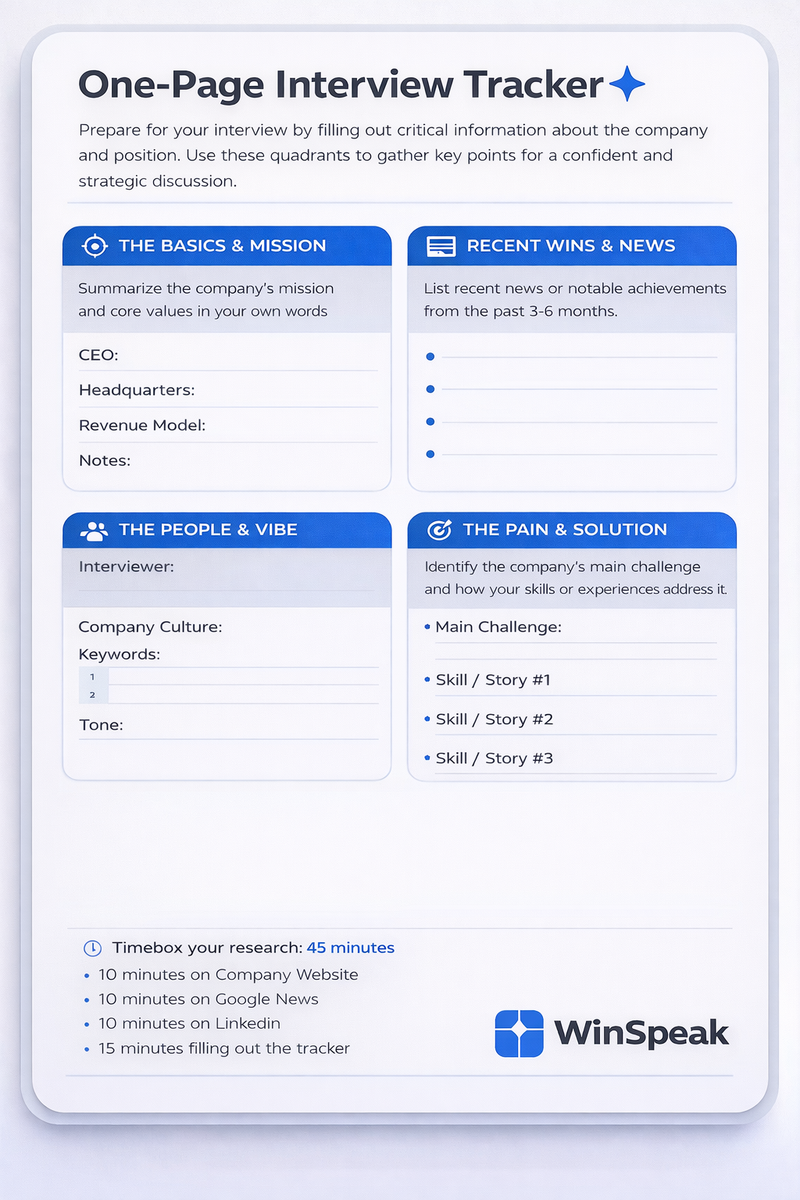
That's exactly why I created a printable one-page tracker that turns scattered Googling into focused, interview-ready preparation. Let's take a look at how it works before you grab it at the end of the article:
To start, you need to understand the four quadrants of valuable intel. These are the ones you will find in our cheat sheet.
This goes beyond just knowing what the company sells: you need to find their "About Us" page and look for their mission statement and core values.
Do not just copy-paste everything; rewrite them in your own words. If their value is "Customer Obsession," note down a time you went above and beyond for a client. This creates a psychological bridge between their culture and your experience.
In this quadrant, also jot down the basics:
Knowing how they make money is surprisingly overlooked by many candidates, and understanding it sets you apart immediately.
This is the fuel for your small talk and your strategic questions.
Go to Google News, search the company name, and look for press releases from the last three months:
Write down two or three specific headlines. When the interviewer asks, "What do you know about us?" you won’t just give a generic answer. You can say:
"I saw you recently expanded into the European market. That must be an exciting challenge for the operations team."
This signals that you are proactive and genuinely interested in their trajectory.
This third section requires a quick trip to LinkedIn.
Look up the person interviewing you. You are not looking for personal details; you are looking for professional context:
Note these details in this quadrant. Furthermore, look at the company’s LinkedIn "Life" tab or their Instagram page. Does the tone feel corporate and buttoned-up, or is it casual and scrappy?
Writing down a few keywords about the tone helps you adjust your own communication style to match theirs, a great psychological concept known as mirroring.
The fourth and most critical quadrant.
Every job opening exists because of a problem. A company does not pay a salary unless there is a gap that needs filling or a pain point that needs soothing.
Based on the job description and your research, write down what you think their biggest challenge is right now:
Next to that challenge, write down three specific skills or stories you have that solve that problem. This is your value proposition. When the interview gets tough, you look at this quadrant to remind yourself why you are the solution they need.
It is also important to timebox this process, because it’s easy to fall down a rabbit hole of reading Glassdoor reviews from five years ago:
If you can’t find the answer to something in that time, it is likely not public information, and that actually gives you a great question to ask during the interview.
Remember, the goal of company research is not to become an encyclopedia; it is to become a consultant. You want to walk in understanding the client (the company) well enough to propose a solution (you).
By condensing your findings onto a single page, you stop worrying about memorizing facts and start focusing on having a compelling conversation.
When you have your tracker filled out, let’s talk about how to use it. The beauty of the one-page format is its accessibility.
If you are in a virtual interview, tape this sheet to the wall behind your computer or have it on the desk next to your keyboard. You can glance at it without breaking eye contact for too long.
If you are in person, bring it with you in a nice notebook. It is perfectly acceptable—even impressive—to have notes in front of you. It shows you prepared seriously.
One of the best ways to utilize your tracker is during the dreaded "Do you have any questions for us?" portion of the interview. Most candidates ask generic questions like, "What is a typical day like?" Instead, glance at your "Recent Wins & News" quadrant. Ask,
"I noticed you just launched that new software feature last month. How is that changing the priorities for this role?"
Or look at your "Mission" quadrant and ask,
"I know one of your core values is 'Move Fast,' how does that play out when you are balancing speed with quality in this department?"
These questions are memorable because they are rooted in research.
Using this tracker also builds a subtle psychological advantage for you.
Anxiety often stems from the unknown: by filling out this sheet, you are mapping the territory and turning a vague, intimidating corporation into a set of understandable facts, people, and goals.
You will find that your voice is steadier and your answers are sharper because you aren't grasping for information; it is all right there in front of you. In your next session of interview prep, ditch the scattered browser tabs and sticky notes.
Download your one-page tracker, fill in the quadrants and visualize the connection between their needs and your skills.
Get your interview research tracker here:
When you treat research as a strategic exercise rather than a homework assignment, you stop hoping for a job and start demonstrating why you are the best person to do it.
Research is crucial, but without practice, you can't apply your knowledge properly.
Developing a daily 5-minute interview practice tailored to your specific industry and company style will get you much further than the competition; and with WinSpeak you can do exactly that.
Our personalized practice platform will give you bite-sized activities crafted around your industry, role and even experience level – from junior to manager. You'll be able to learn the best ways to communicate within your role or the best techniques to land that position you've been dreaming of.
Join our waitlist now at winspeak.ai to get more information and receive early access when available.
Try a new way to get interview-ready with WinSpeak

Vague interview answers like "I improved efficiency" cost you offers by making impressive work forgettable. The "From X to Y" framework—borrowed from strategic goal-setting and OKRs—fixes this with a simple formula: "I moved [metric] from X to Y by [when]." Pair it with the STAR method to transform weak results into quotable, defensible impact. Whether you're a manager, designer, marketer, or data professional, almost every role produces measurable change worth quantifying. Learn how to build your own before-and-after stories before the interview, hunt down your numbers, and communicate your impact with the precision that wins offers and makes you impossible to forget.

Polished interview answers backfire. Discover why owning real mistakes, showing self-reflection, and embracing honest imperfection wins offers over rehearsed perfection.

Walking into a teacher interview prepared with the right vocabulary can instantly set you apart. This guide breaks down how middle and high school hiring panels expect candidates to discuss modern teaching frameworks like Differentiated Instruction, PBL, SEL, UDL, and Restorative Practices. Learn smart, specific answers to the most common interview questions, from teaching philosophy to handling disruptive students and using data. Discover how to plan a sample lesson with Backward Design, weave in compelling STAR-method stories, and ask questions that show you're evaluating fit. Walk in sounding less like a candidate and more like the colleague they want to hire.

Job interviews can feel overwhelming, especially when open-ended questions like "Tell me about yourself" leave you scrambling for words. The Past-Present-Future framework offers a simple yet powerful solution, structuring your answers into three clear segments: your background, your current role and skills, and your future ambitions. This storytelling approach helps you communicate with clarity, confidence, and intention. Ideal for introductions, career pivots, and questions about your goals, PPF transforms scattered responses into compelling narratives. Learn when to use it, see real examples, and discover practical tips to make your interview answers feel natural and memorable.
Receive new WinSpeak blog posts the moment they're published.